
Considering a new homeschool year can feel like standing at the beginning of a long journey: exciting, but also a little overwhelming.
Where do you begin? How do you keep going when life gets busy? How do you make sure your children grow not only academically but also in faith?
Kolbe’s Homeschool Course Plans are designed to help you navigate these questions. They’re not just roadmaps for the school year; they’re tools to give you confidence, structure, and the freedom to adapt homeschooling to your family’s unique rhythm.
In this article, the first in a four-part series, we’ll explore how Kolbe’s Homeschool Course Plans work, how Kolbe’s digital homeschool program builds on them, and the development of the home educator. We’ll also share some exciting updates and improvements to our course plans. Whether you are new to Kolbe or a longtime family, you will find tools, tips, and insights to support your homeschool journey.
Meet the Team Behind Kolbe’s Course Plans
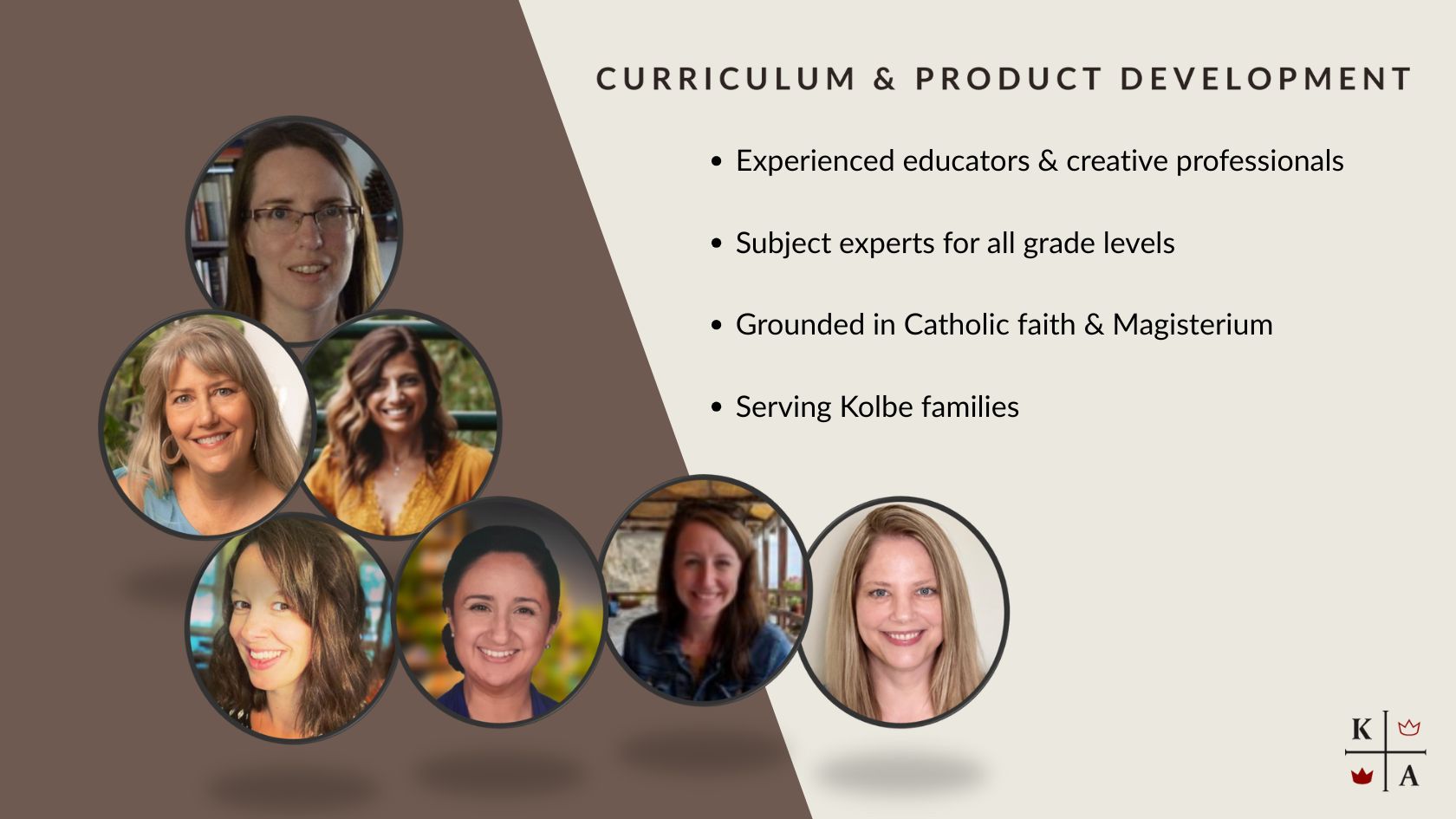
Every Kolbe course plan begins with people. Our curriculum contributors include:
- Homeschooling parents
- Former homeschoolers
- Experienced teachers
- Subject matter experts
- Skilled writers and copy editors
- Professional artists and graphic designers
Behind every Kolbe course plan is a team of creative professionals, as well as educators and homeschooling parents with real-world experience in both classrooms and homeschool settings. Most work part-time on curriculum projects while remaining active in teaching, homeschooling, or both, grounding our materials in the Catholic faith and in what truly works. This approach ensures our plans are academically strong, faithful to the Magisterium, and practical for families like yours.
What’s in a Kolbe Course Plan?
Each Kolbe course plan is a structured weekly roadmap for a specific course. While the exact contents vary by course, subject, and grade level, there are several common elements you’ll see in every course plan.
The plans help you teach confidently, stay organized, and adapt lessons to your family’s needs, all while laying the foundation for a classical, Catholic education that comes into full focus in the later years.
Most plans include:
- Syllabus with course texts
- Weekly or daily plans
- Exams and answer keys
- Paper topics and keys
- An appendix with rubrics, enrichment, or extra resources
Best of all, course plans are flexible. They give structure, but you can always adapt them for your family’s needs.
Anatomy of a Course Plan
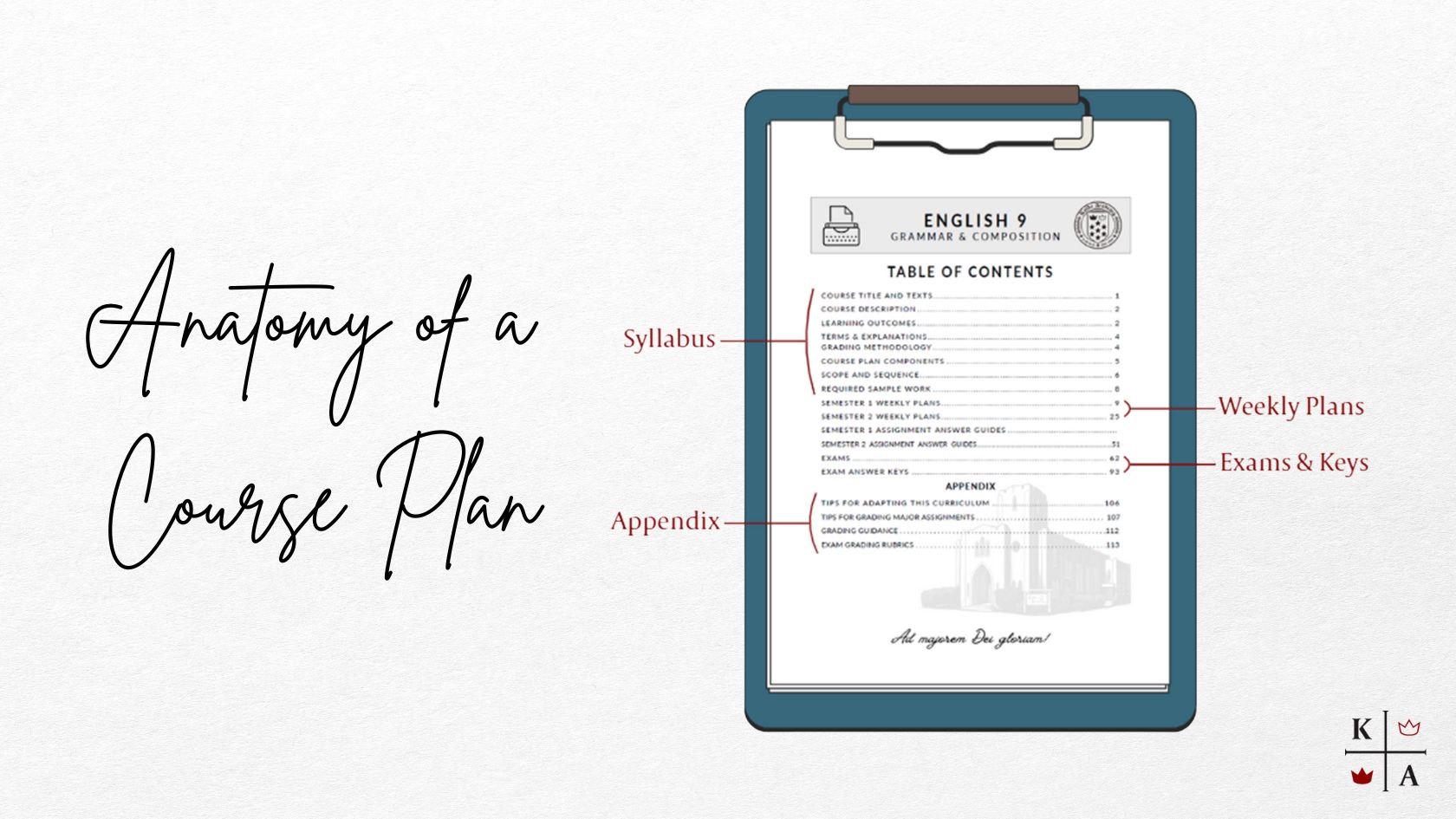
At the front of the course plan, you’ll find a table of contents. Next, the syllabus is comprised of the course description, a list of course texts, learning outcomes, an explanation of the course components (which is sometimes called methodology in older plans), and a scope and sequence. High school plans will also include requirements for grade reporting and designations for high school transcripts.
Next you’ll find the weekly plans that list page numbers, exercises, and sometimes discussion questions as well as major assignments. Many weekly plans also include key notes that offer background or extra guidance for providing instruction for the week.
All plans include exams and answer keys. However, many course plans include an appendix with additional materials or other designated sections, which are found at the back of the course plan and vary by course. These additional materials may include things such as writing rubrics, grading support, enrichment activities, or even some course content such as additional reading or workbook pages.
Companion Materials
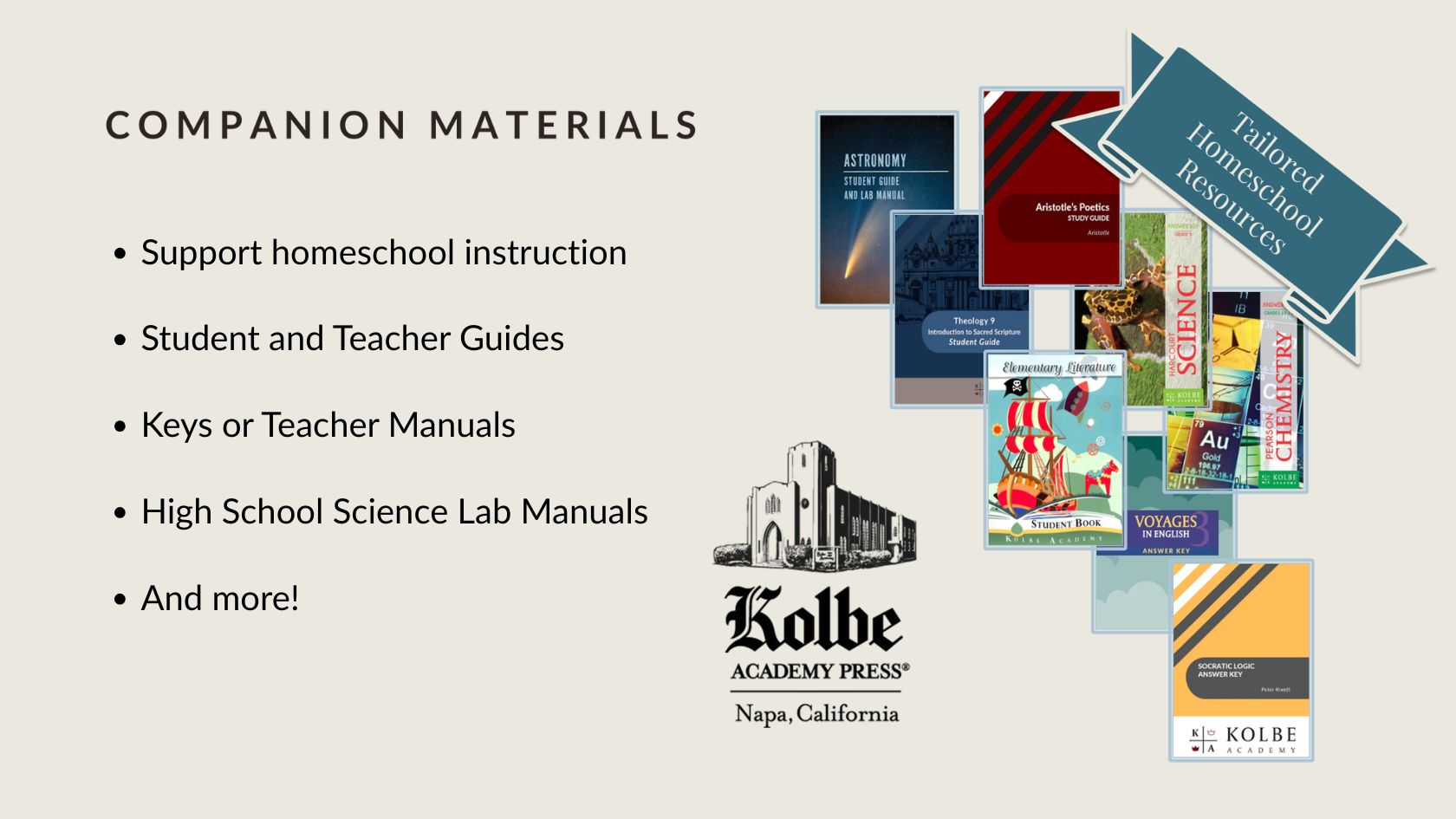
Along with our course plans, we offer companion materials to support you as a home educator. In our high school humanities courses, you’ll find detailed student and teacher guides available in the bookstore. We have similar guides in literature at every grade level, and in other subjects across our homeschool program—including lab manuals for high school science.
Often, you can skip the bulky classroom manual. We publish custom answer keys and teacher resources specifically for homeschool use along with our course plans. And when a manual really is helpful, we’ll have it in our bookstore and often note it as a recommended resource.
The goal is simple: more time focused on learning, and less time and money on expensive materials written for a traditional classroom.
Getting Started
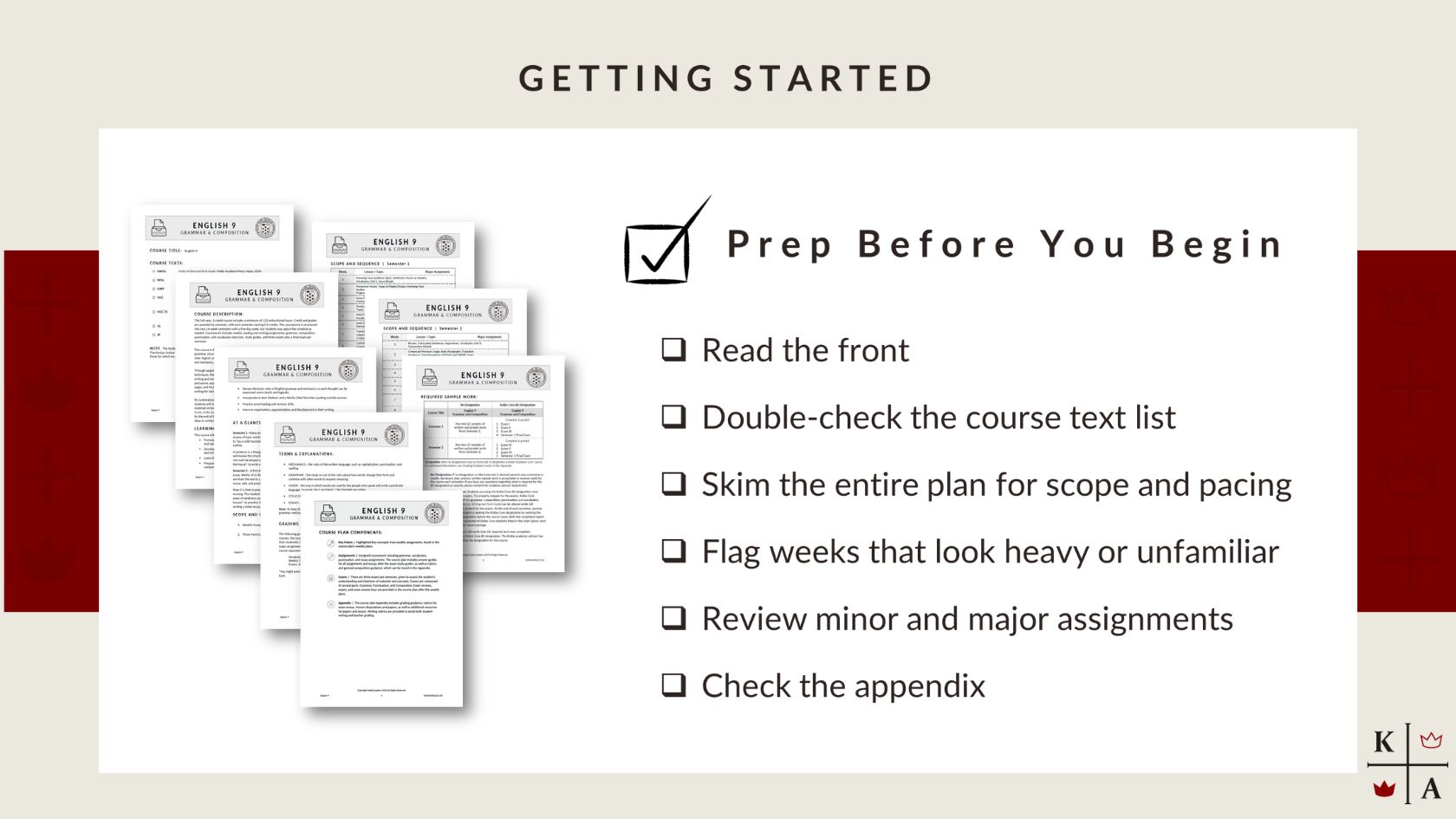
It can be overwhelming to begin the new year, but you can approach this methodically and wrap your arms around what’s in front of you, so you become more comfortable even before you find your weekly rhythm. Before diving into lessons, we encourage you to take a little time to prepare:
- Read the front pages of the plan
- Check the book list to be sure you have everything
- Skim the year’s pacing for a big-picture view
- Flag busy weeks that look heavy or unfamiliar
- Review minor and major assignments
- Check the appendix
This quick orientation saves you time and surprises later.
Mapping Out Your Year
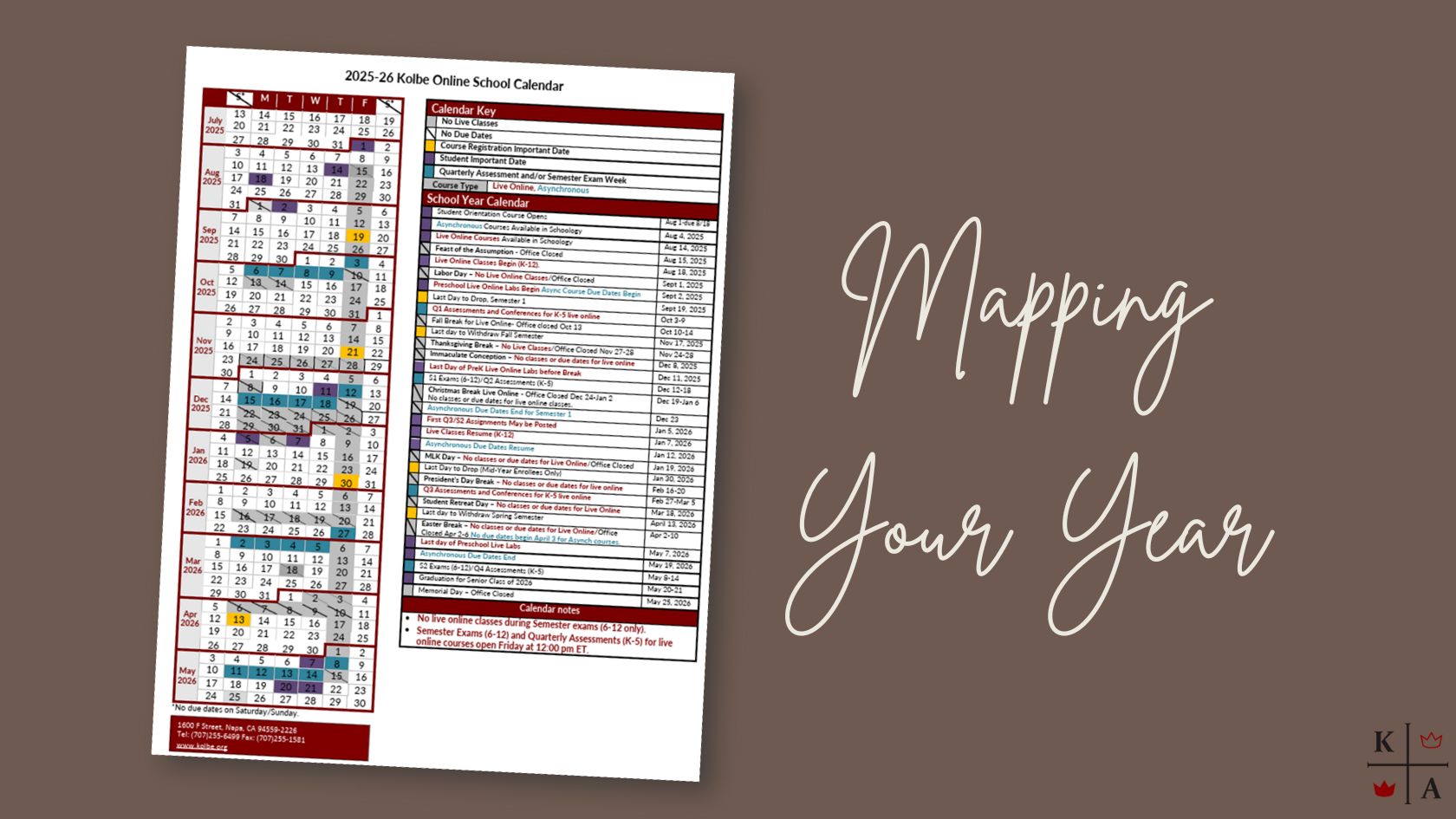
Once you’re familiar with the plan, it’s time to set a pace.
- Use Kolbe’s online course calendar if your student has live classes.
- Most plans follow a 16-week semester pace.
- Add review weeks before exams if needed.
- Adjust pacing to match your family’s rhythm.
- Review your family’s overall calendar for the year
- New baby
- Family vacation
- Moving
- Review your family’s overall calendar for the year
- Consider incorporating liturgical living into your plans.
- Choose a few saint days or holy days to celebrate. It doesn’t need to be complicated! Something as simple as dessert or taking some moments to ask for the saint’s intercession.
- Use Kolbe’s Liturgical Living resource.
- Read a story or learn about a saint on their feast day.
The key is setting a pace that supports your student’s learning without creating unnecessary stress.
Staying on Track (Without Stress)
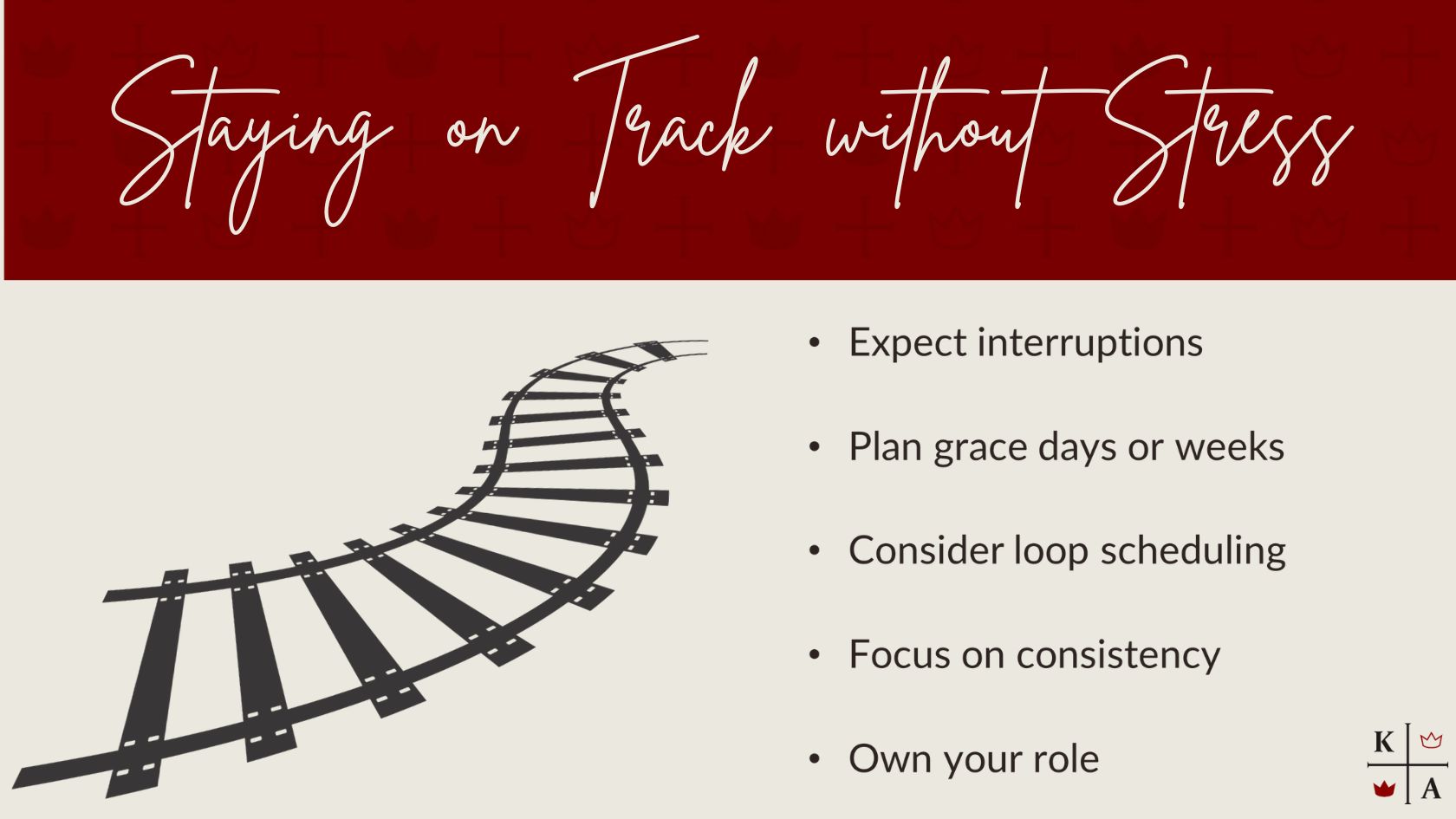
Life happens—illness, travel, emergencies. That’s not failure. Having the flexibility to adapt to these challenges is one of the benefits of homeschool.
Here are strategies that work for many Kolbe families:
- Build in grace days (or better, weeks!) into your plan for the year.
- Try loop scheduling (like a homeschool playlist—just pick up where you left off).
- Focus on consistency, not perfection.
Treat your role as a home educator like the important work it is; plan for grace, but also show up for work consistently, just as you would any job you care about. And remind yourself often: progress over perfection.
Day-to-Day Rhythm
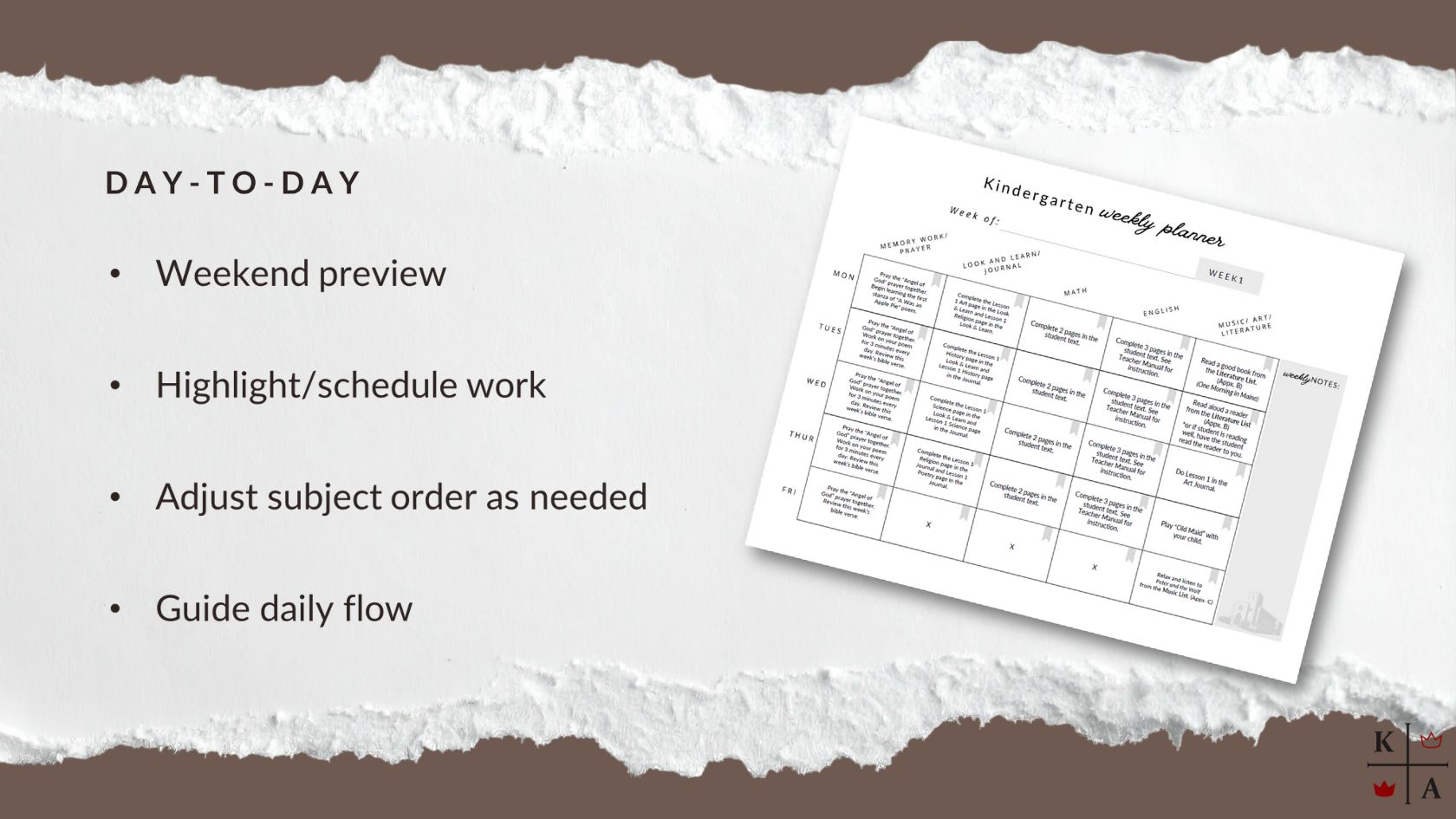
A simple weekly routine helps you and your student feel grounded. Many parents use the course plan practically: review the week ahead on the weekend, get a sense of the flow, and plan their days accordingly. Use the course plan as a daily checklist or input into a paper or digital planner. This gives structure, a pace for the week, and a clear sense of progress. Kolbe’s Preschool and Kindergarten course plans do this for you!
- Preview the week ahead each weekend.
- Highlight or schedule assignments.
- Adjust subject order as needed.
- Use the plan as a daily checklist.
Customizing for Your Family
Our course plans are complete and thoughtfully designed for each subject and grade level, ensuring that students are learning what they need now while also preparing for future studies. At the same time, you, as the parent-educator, are the expert on your child and family. The course plan is ready to use as-is, but it also leaves room for your judgment and creativity.
We provide the framework, and you, as an empowered educator, have the freedom to shape the learning experience to fit your child’s needs and your family’s interests. If your child has already mastered a concept, you can skip it. If your family enjoys documentaries, crafts, hands-on projects, or field trips, you can incorporate them. Supplemental books, videos, games, and activities can further enrich learning.
In the younger years, combining teaching for multiple ages can work well in subjects that lend themselves to shared learning experiences like history, science, religion, or art. Families often explore group activities, art appreciation, and music to make the most of multiple ages learning together. With older students, combining subjects is sometimes possible but requires careful planning to meet each student’s learning needs while ensuring that course adaptations maintain the integrity of the course and satisfy requirements for high school credit or college preparation.
This flexibility allows you, as the empowered home educator, to take ownership of your child’s education, making the curriculum truly your own while ensuring students are prepared for both current and future studies. Your Family Advisor can offer guidance and suggestions, but as the home educator, you are the one who shapes your child’s learning experience.
Building Independence with a Student Planner
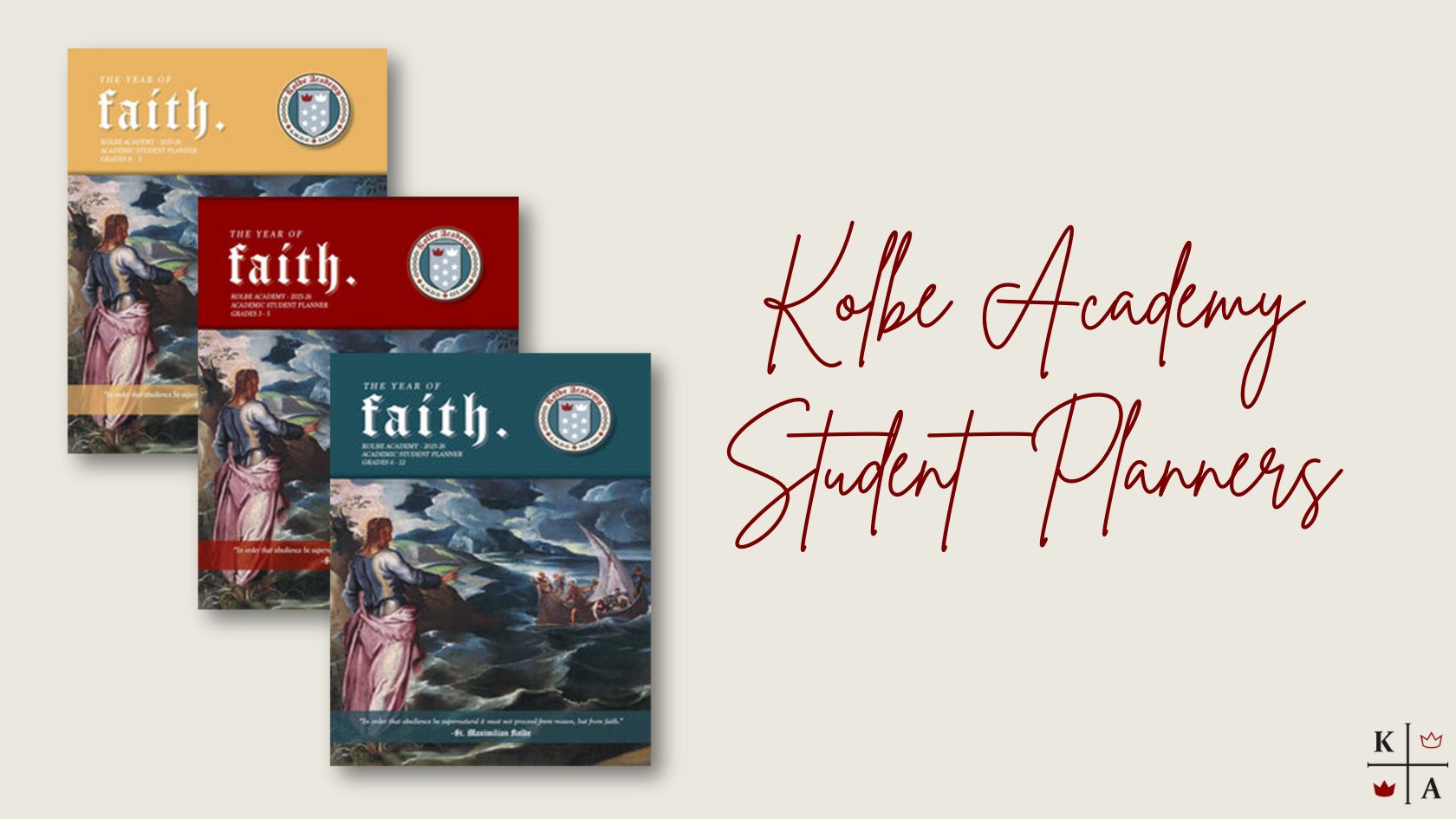
A student planner is a powerful tool for building independence. Start by choosing a layout—weekly works well for older students, while younger kids may benefit from a simple daily checklist or a workbox system. Transfer key assignments into the planner at the beginning of the week, or let your child help. Encourage him to check off tasks as he goes. This teaches responsibility, planning, and time management.
Match independence expectations to your child’s age, maturity, and needs. Most children need hands-on support in elementary school, close accountability in junior high, and some support in high school, with a few needing more until high school graduation.
The Kolbe bookstore carries my favorite planner, so be sure to check it out if you’re still looking. This student planner also helps support liturgical living.
Kolbe Academy Student Planners
Maximize Your Support
Beyond our comprehensive course plans, Kolbe offers a wealth of support for homeschool families. The Kolbe Portal puts your digital course plans right at your fingertips. Your Family Advisor and the Help Center are there to guide you whenever you need help.
Most importantly, don’t forget the power of community—online groups, local co-ops, and experienced parents can share tips that save you time and headaches. For even more ideas, explore the Kolbecast and Kolbe’s blog. Tap into these resources early to build confidence in navigating the year ahead.
The Bottom Line
Kolbe’s course plans are designed to give you:
- Structure without rigidity
- Confidence without pressure
- Faithful Catholic education for your family
As you begin, remember: progress over perfection. Consistency and faithfulness matter far more than checking every single box.
And if you’re curious about how Kolbe’s digital homeschool courses pair with these plans—with video content, auto-graded checks, and weekly pacing—stay tuned for our next post! If course plans are the heart of Kolbe homeschooling, digital homeschool is the helping hand. Join us in Part 2 of this series as we explore how Kolbe blends tradition with technology.
Ready to explore course plans for your family?
Visit the Help Center to get started:
Elementary Course Plan Samples
Junior High Course Plan Samples
High School Course Plan Samples


